Mathematical techniques for engineers: Complex analysis
2.1.1 Continuity Definition:
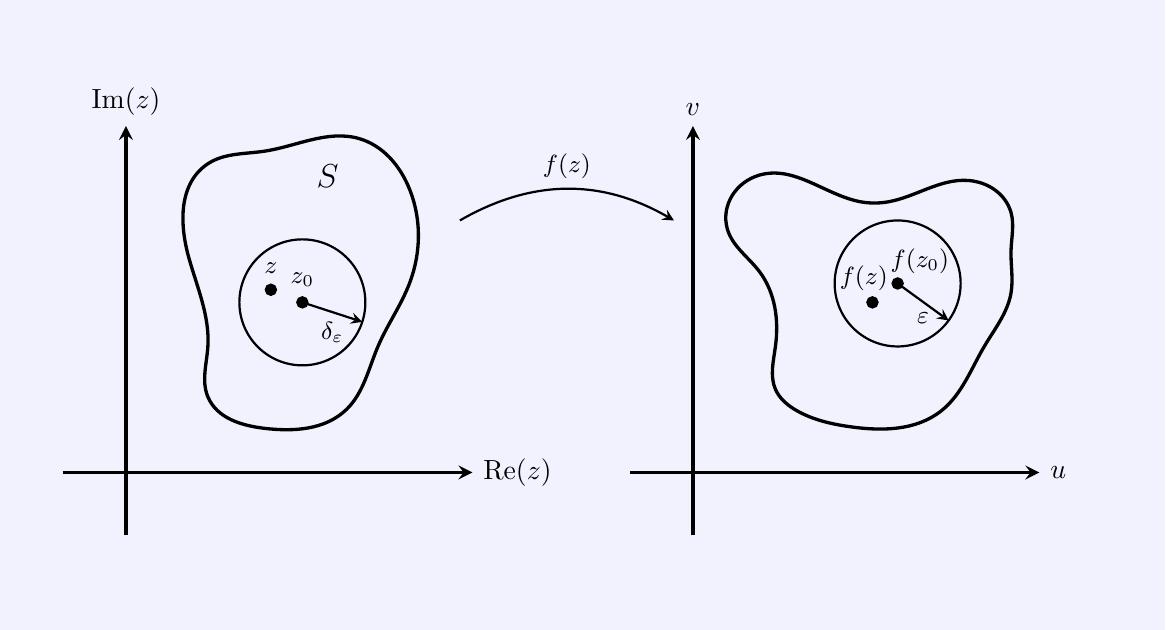
The function $f$ is continuous in $z_0$ if $( \forall \varepsilon > 0)(\exists \delta_\varepsilon > 0)(\forall z \in S)(\lvert z-z_0 \rvert<\delta_\varepsilon \Longrightarrow \lvert f(z) - f(z_0) \rvert<\varepsilon)\, . $
2.4 Geometrical Interpretation Of The Complex Derivative:
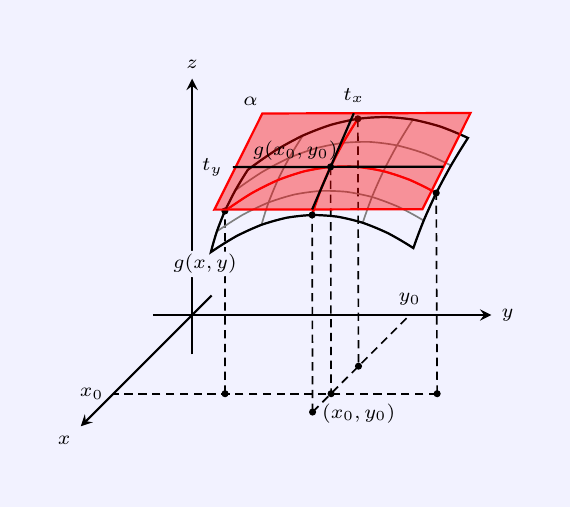
In every point $g(x_0, y_0)$ of a surface $g(x,y)$, a tangent plane can be drawn (red). The tangent lines $t_x$, $t_y$ are oriented according to the $x$- and $y$-axis, respectively. They have a slope which corresponds to the partial derivatives $\frac{\partial}{\partial x}$ and $\frac{\partial}{\partial y}$, respectively.
3.2.12 Symmetry of points:
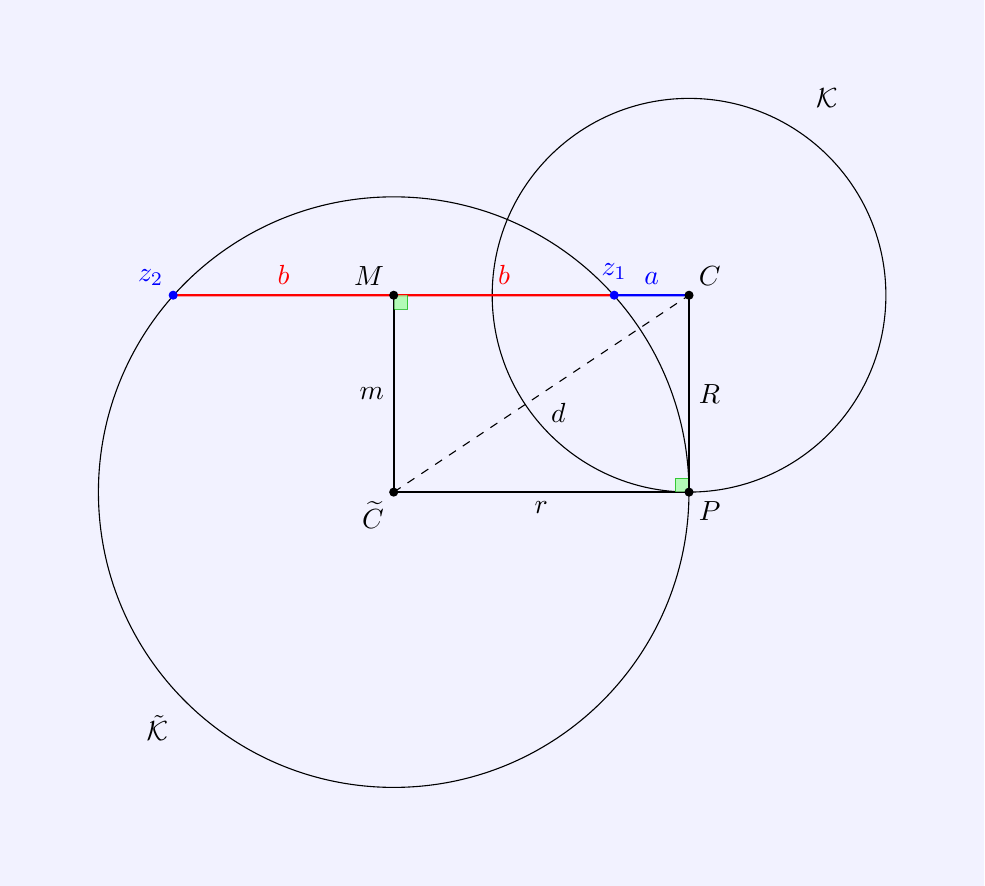
The points $z_1$ and $z_2$ are symmetrical with respect to the circle $\mathcal{K} = S(C,R)$.
3.5.1 Exponential function periodicity:
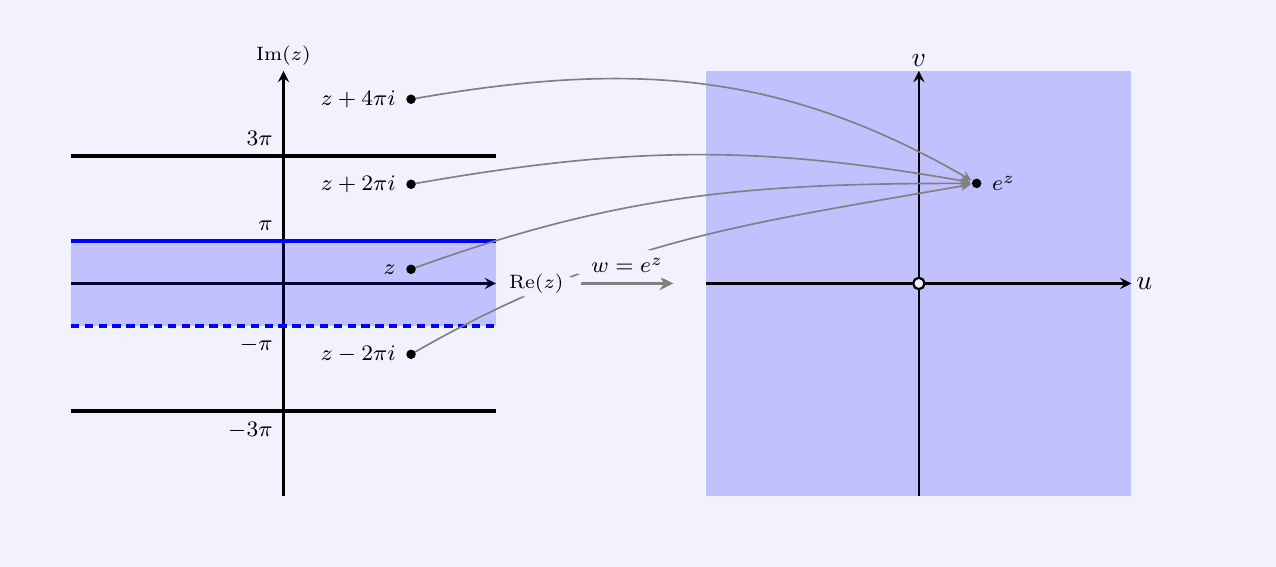
The exponential function $f(z) =e^z$ is periodic with period $2 \pi i$.
3.5.2 Exponential function image vertical lines:
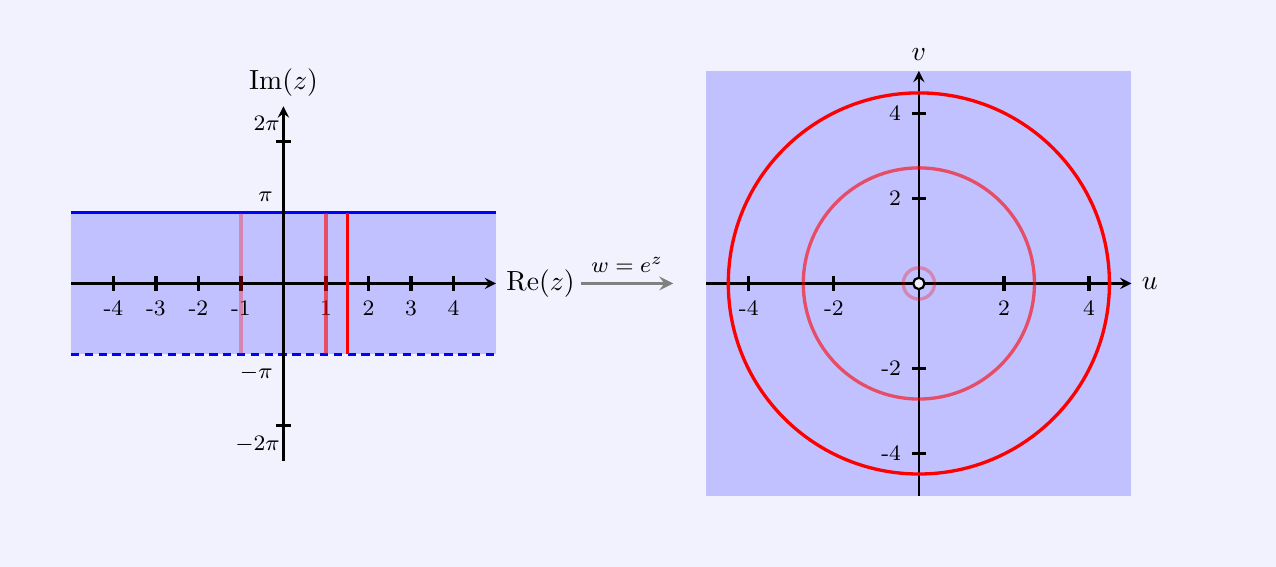
The exponential function $f(z) = e^z$ maps vertical lines onto circles centered at the origin.
3.5.3 Exponential function image horizontal lines:
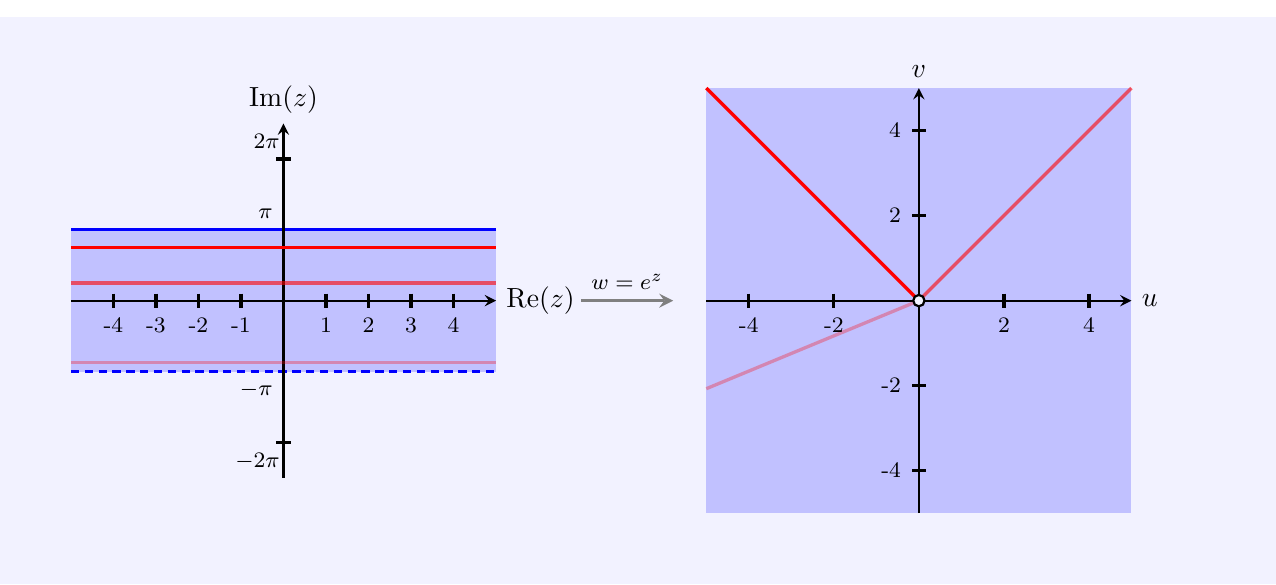
The exponential function $f(z) = e^z$ maps horizontal lines onto half-lines originating from the origin.
3.8.4 Exercise:
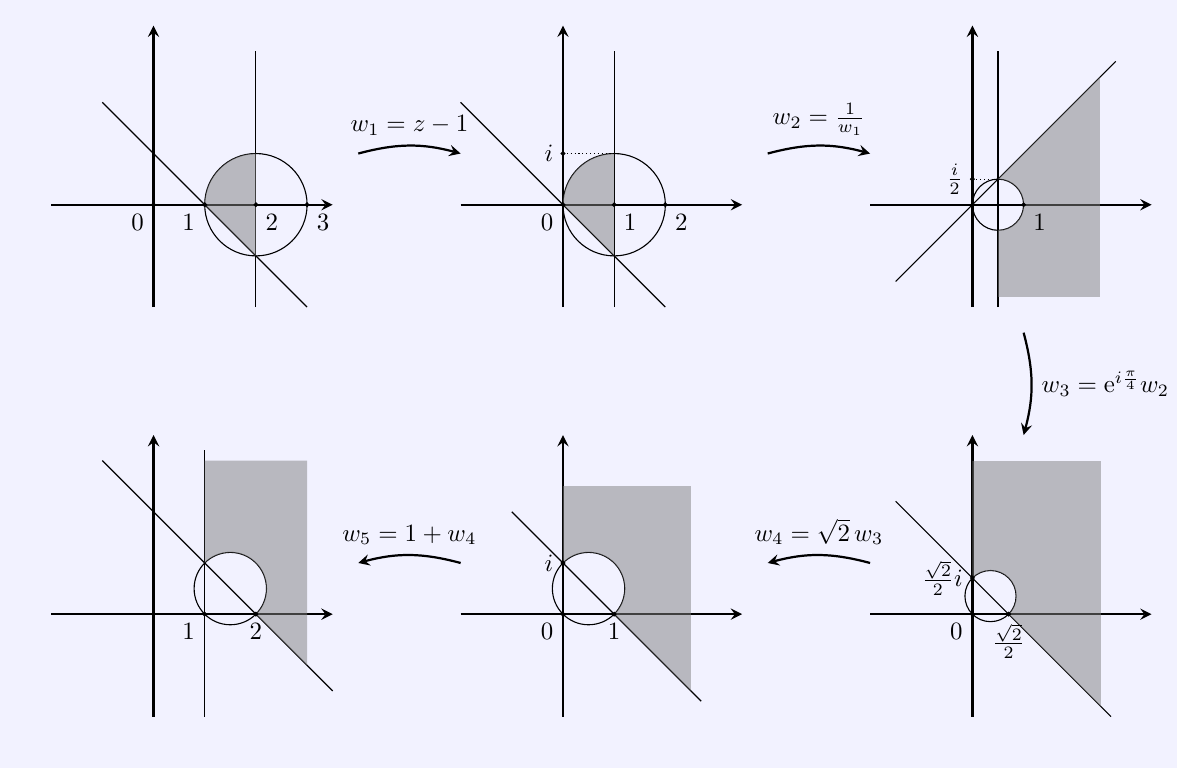
Image of domain $\mathcal{D} = {z\in \mathbb{C} \vert \mathrm{Re}(z) + \mathrm{Im}(z) \ge 1, \lvert z-2 \rvert \le 1, \mathrm{Re}(z) \le 2 }$ through the function $f(z) = \frac{z+i}{z-i}$.
5.1.1:
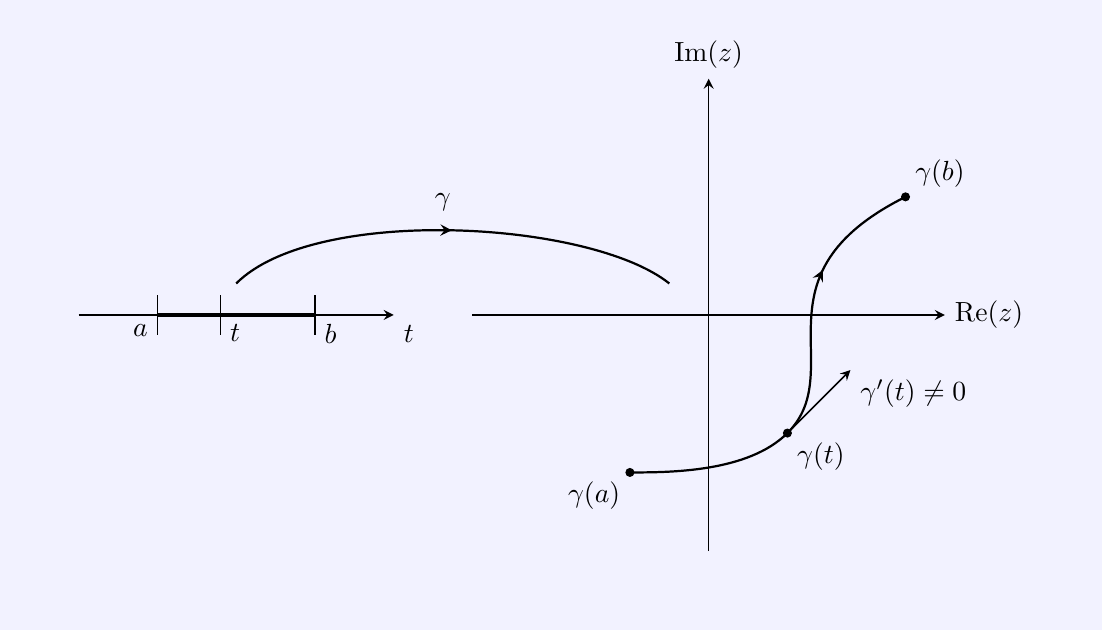
The complex line integral $\int_C f(z)\,dz$ for $z=\gamma(t)$, $t \in [a,b]$, with $\gamma(t)$ a smooth curve, can also be seen as an integral over $t$ with the equation $\int_C f(z)\,dz = \int_a^b f(\gamma(t))\,\gamma’(t)\,dt$.
5.2.3:
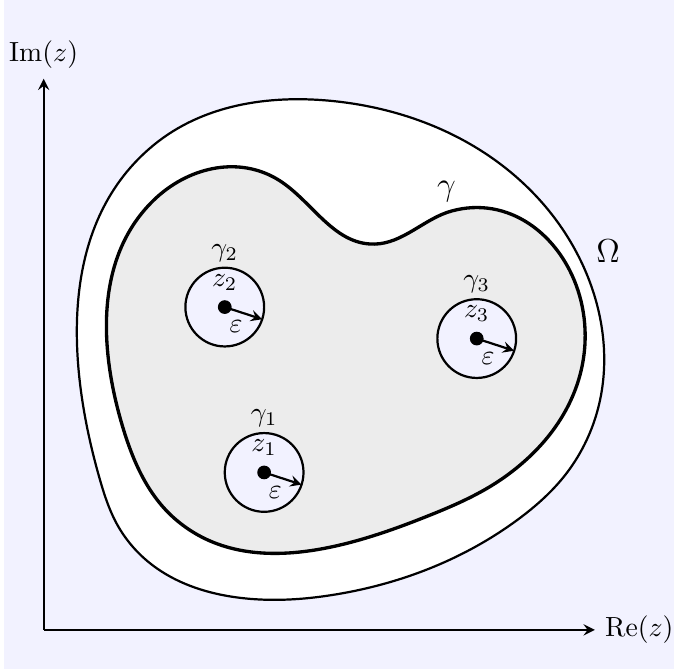
The integral over a contour $C$ in $\Omega$ with an interior with a finite amount of singular poles is the sum of the integrals over the circles around these interior poles.
5.3 Cauchy integral formulas and consequences:
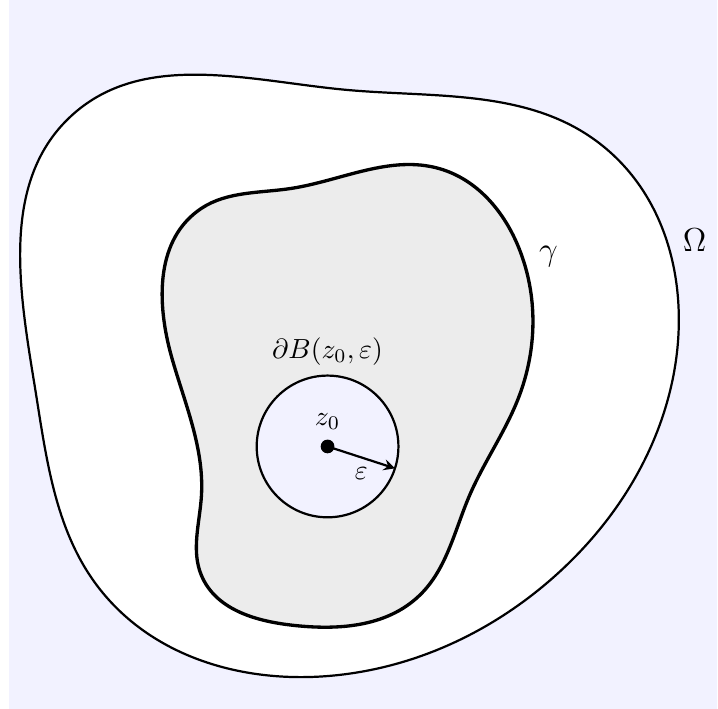
$\mathcal{C}$ is a bounded contour in $\Omega$ which encloses a compact set $K$ lying completely within $\Omega$. For a point $a \in \mathcal{C} \setminus K$, we parametrize the circle $\partial B(a, \epsilon)$, which lies entirely in the interior of $\mathcal{C}$.
5.4.4:
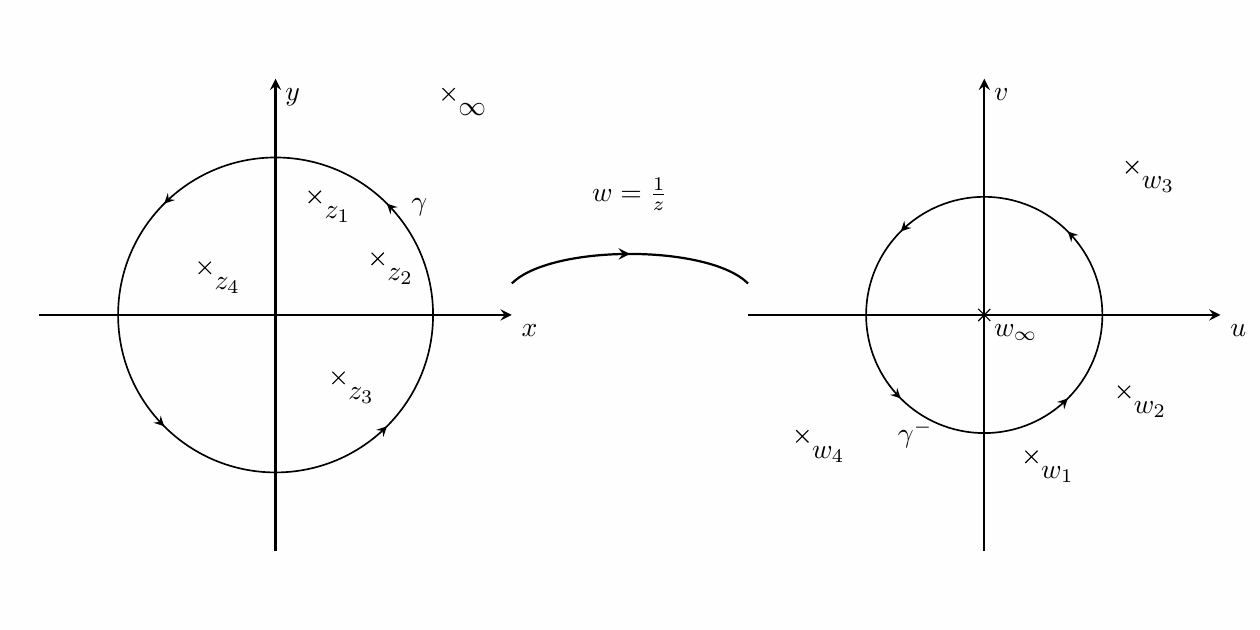
To define the residue of a isolated singular pole at $z=\infty$, we can evaluate the integral of a contour in which all other poles lie. By taking the reciprolal equation $w=\frac{1}{z}$ we get an integral around the origin that only contains the pole $w=0$. Which proves $\operatorname{Res}(f(z), \infty) := -\frac{1}{2\pi i} \oint_{\gamma} f(z)\,dz$.
5.5.2 Uniqueness of holomorphic functions:
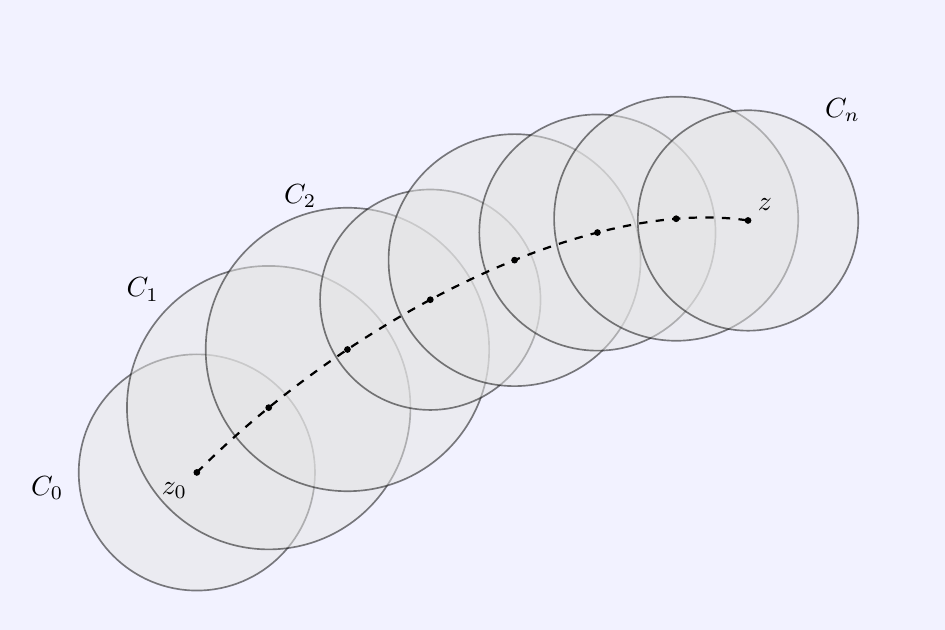
Let $f$ be holomorphic in the space $\Omega \subseteq \mathbb{C}$. If $z_0 \in \Omega$ is an accumulation point of zeros of $f$, then $f\equiv 0$ over the entire space $\Omega$.
5.6.2:
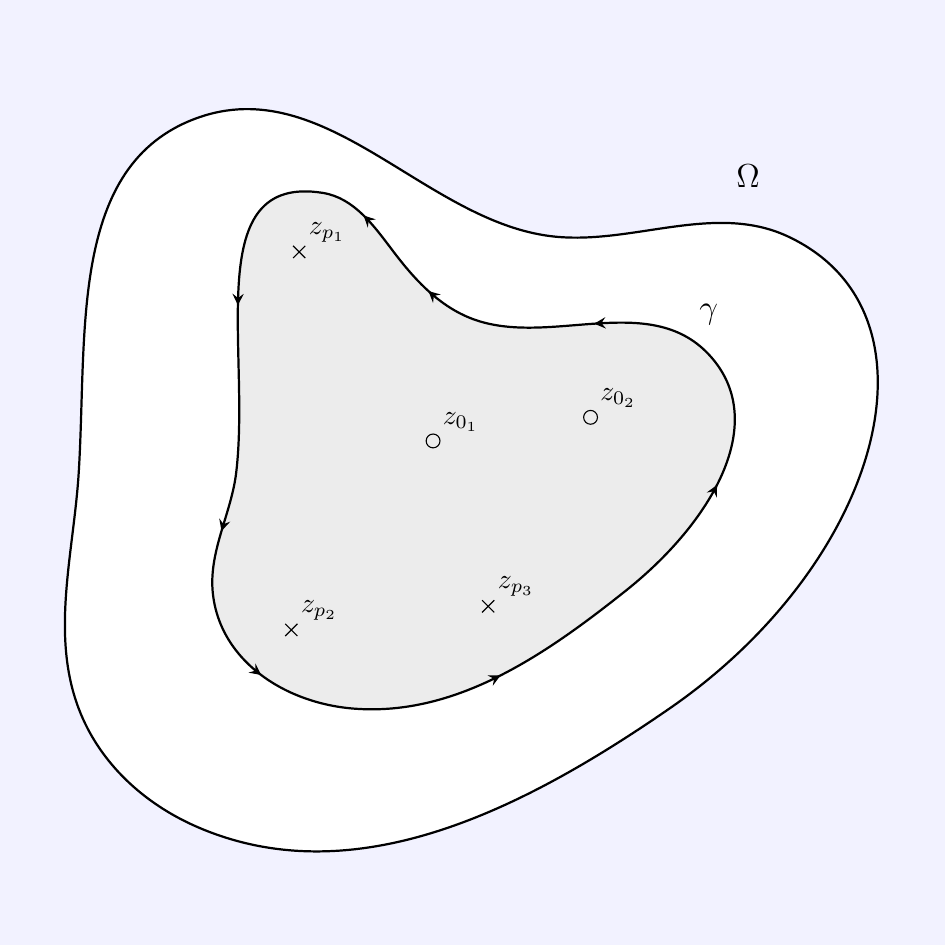
The argument principle gives for a closed, smooth Jordan curve $\gamma$, entirely within the domain $\Omega \subseteq \mathbb{C}$, and $f$ a meromorphic function in $\Omega$ whose poles all lie inside $\gamma$, and such that $f(z) \neq 0$ for $z \in \gamma$. $\frac{1}{2\pi i} \oint_{\gamma} \frac{f’(z)}{f(z)}\,dz= N_{\gamma}(f) - P_{\gamma}(f)$,where $N_{\gamma}(f)$ and $P_{\gamma}(f)$ denote, respectively, the number of zeros and poles of $f$ inside $\gamma$, each counted with multiplicity.
5.6.3 Argument Principle:
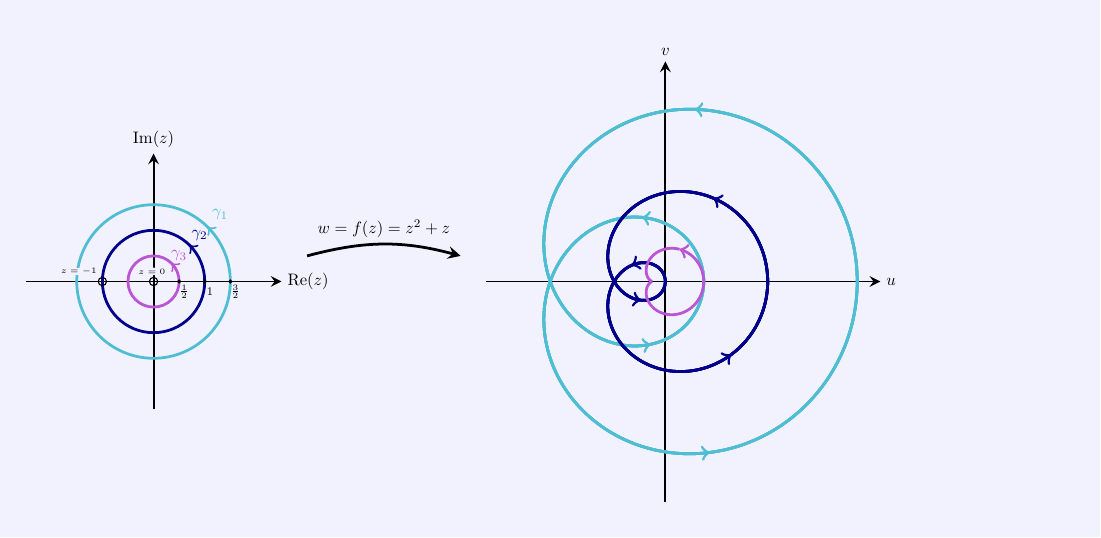
Illustration of the argument principle for $ f(z) = z^2 + z $. The images of the circles $ \gamma_1, \gamma_2, \gamma_3 $ under $ f $ show how many times each curve winds around the origin, corresponding to the number of zeros of $ f $ inside each circle.
5.6.3 Rouches theorem:
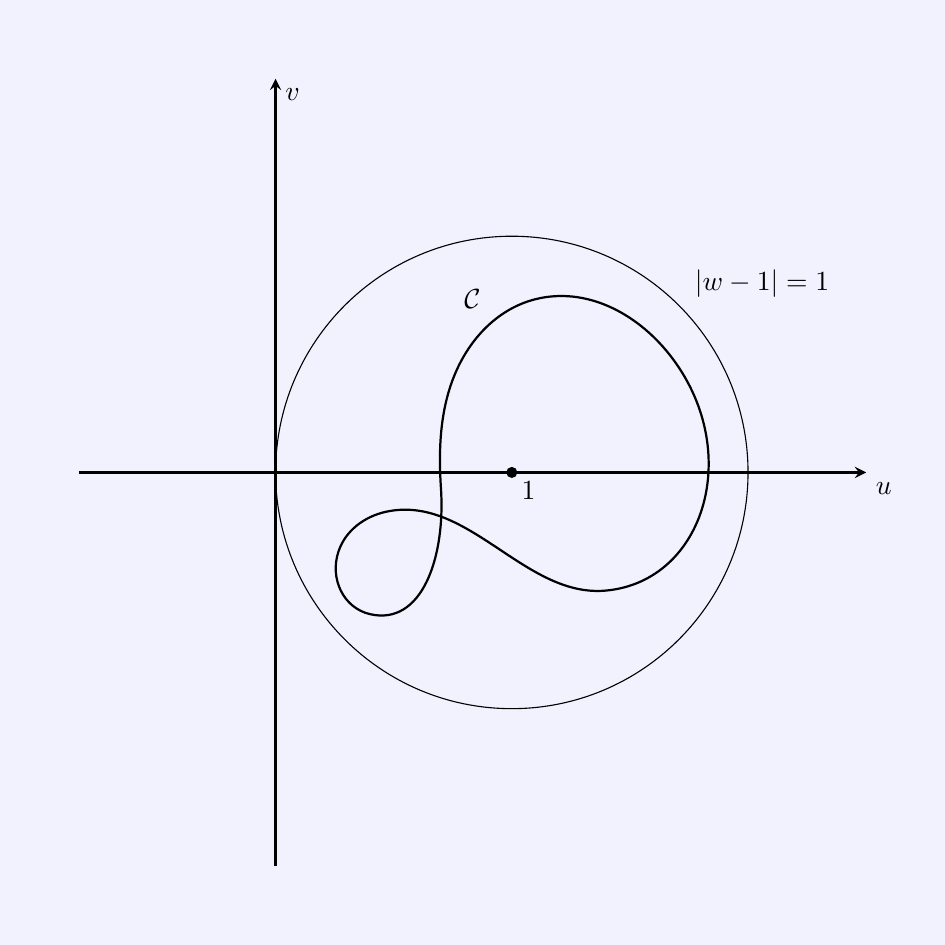
To prove the theorem of Rouché: For $f$ and $g$, holomorphic functions on and inside a closed, smooth Jordan curve $\gamma$ in $\mathbb{C}$. If $|g(z)| < |f(z)| \quad$ for every $z\in \gamma$, then $N_{\gamma}(f) = N_{\gamma}(f + g)$. We use that $F(z)=\frac{f(z)+g(z)}{f(z)}=1+\frac{g(z)}{f(z)}$ and $\lvert\frac{g(z)}{f(z)}\rvert<1$. We get a contour inside the unit circle around $1$.